

Driving up Interstate 17, it is almost impossible to miss the big brown National Park Service signs for Montezuma Castle National Monument. Located just outside Camp Verde, it bills itself as one of the best-preserved ancient cliff dwellings in North America.
The dwelling built high up in the white limestone alcove looks cool, but you’ll quickly realize this is a quick roadside stop, not an afternoon adventure.
If you are deciding whether to pull off the highway, here is what you need to know about the trail, the cost, and whether it deserves a spot on your Arizona itinerary.

Quick Logistics: Hours, Cost, and Trail Stats
- Distance: 0.3-mile loop
- Trail Surface: Flat, fully paved sidewalk (wheelchair- and stroller-friendly)
- Time Needed: 30 to 45 minutes total
- Hours: Daily 8:00 AM – 5:00 PM (gates close to incoming traffic shortly before 5:00 PM)
- Cost: $10 per adult (ages 16+), kids 15 and under are free
- Passes: Free entry with an America the Beautiful Interagency Pass
- Pet Policy: Leashed dogs are allowed on the paved outdoor loop trail, but not inside the visitor center
What to Expect: Why Montezuma Castle Might Underwhelm
To set expectations clearly from the jump: Montezuma Castle is a one-hit wonder.
The five-story, 20-room cliff house is an impressive architectural feat, but it is the only major structure you get to see. You cannot climb up to it, touch the stone, or explore inside. The National Park Service banned public entry back in 1951 to keep the fragile, ancient mud-and-limestone mortar from crumbling under foot traffic. Today, you view the dwelling from a paved path roughly 90 feet below.

Ultimately, if you are paying $10 per person out of pocket, a couple or family spending $20 to $40 for a 15-minute paved stroll might leave feeling shortchanged. But if you already carry an America the Beautiful Pass, it becomes an easy, 30-minute leg stretcher right off the interstate.
Walking the Paved Loop: What You Actually See
The trail begins right out the back doors of the small visitor center and gift shop. It is a mostly flat, shaded loop lined with towering Arizona sycamores.

Depending on daily staffing, rangers occasionally host brief, informal 15-minute talks out on the back patio or near the main overlook. They are worth stopping for if you happen to catch one, but schedules vary too much to count on them ahead of time.

The Cliff Dwelling Alcove
Within about two minutes of leaving the visitor center, you hit the primary viewpoint. Looking up at the sheer cliff face, the dwelling sits in a natural limestone recess.

From the path, look closely at the masonry: if you look near the upper floor lines, you can still make out original sycamore ceiling beams sticking out between the stone layers. The structure was built between 1100 and 1425 CE by the Southern Sinagua people, who farmed the fertile creek bottom below. The name “Montezuma Castle” was coined by early European settlers who incorrectly assumed the Aztecs built it, though Emperor Montezuma never set foot within a thousand miles of here.
Photo Tip: The alcove faces south. Mid-morning to early afternoon delivers the most even, direct light across the masonry without casting deep, awkward shadows over the front windows.
Castle A Ruins
A few hundred yards down the path, interpretive signs point out “Castle A.” In its prime, this was an even larger, 45-room cliff-and-base pueblo that dwarfed the main dwelling.

Unfortunately, there is very little left to look at today. A severe fire in antiquity and subsequent centuries of weather took their toll, leaving behind only faint foundation lines and low rock rubble hugging the cliff base. It offers interesting context on how densely populated this little canyon used to be, but visually, it is easy to overlook.
Beaver Creek and Sycamore Shade
The trail continues around the loop and curves along the banks of Beaver Creek. Depending on the time of year, water levels range from a gentle trickle to a steady desert stream.

The real standout along the water is the canopy: massive, twisty Arizona sycamores provide cool shade across the entire sidewalk.

The Outdoor Cutaway Display and Benches
Just past the creek stretch, you will run into a small shaded wooden kiosk housing a cutaway diorama of the cliff dwelling. Because no one has been allowed inside the ruins since 1951, this display is your only real glimpse into how the five stories were actually laid out. It shows the cross-section of the rooms, the ladder placements between levels, and how families utilized the cramped stone spaces.

From there, a few shady benches line the final stretch of sidewalk, making a quiet spot to listen to the cicadas and take a breather before walking back through the visitor center doors.

Maximizing Your Entry Fee: The 7-Day Tuzigoot Tie-In
If you do not have an America the Beautiful Pass and are paying the $10 entry fee, make sure you keep your receipt.
Your entry fee covers admission to both Montezuma Castle and Tuzigoot National Monument for seven consecutive days. Tuzigoot is located about 35 minutes west near Clarkdale and Cottonwood. Unlike the hands-off view at Montezuma Castle, Tuzigoot is an expansive hilltop pueblo that lets you walk right through restored stone rooms and step out onto an open rooftop tower overlooking Tavasci Marsh.
Splitting that $10 ticket across two national monuments makes the overall value far more reasonable.
Montezuma Castle vs. Montezuma Well: Which Is Better?
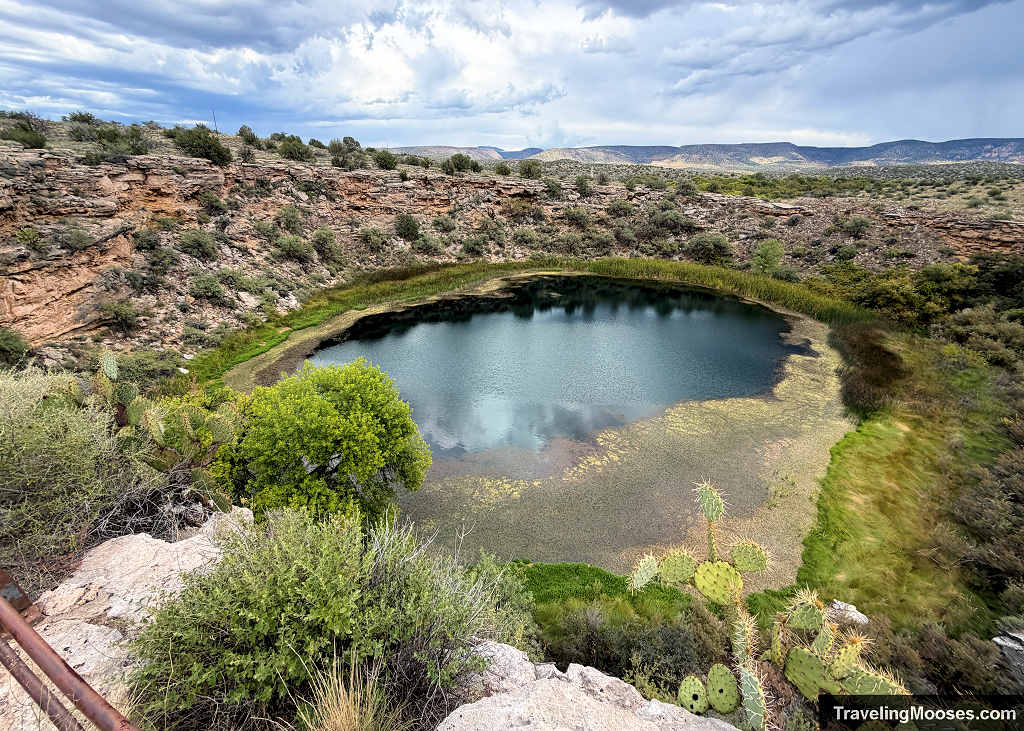
We did not realize Montezuma Castle had a detached sister site called Montezuma Well, located just 11 miles north off I-17.
Between the two, Montezuma Well is arguably the more interesting, rewarding stop. While the castle is a quick sidewalk peek, the Well offers a dynamic desert walk around a massive limestone sinkhole pumping out 1.5 million gallons of water every day. You get to walk down stone stairs right to the water’s edge, wander alongside an ancient Sinagua irrigation canal that still flows, and take in far more varied scenery.
Best of all? Montezuma Well is completely free to visit, with no entry kiosk or parking fee required.
(Check out our complete Montezuma Well Trail Guide: You’ll Regret Skipping This for full details on stairs, trails, and what to watch out for.)
How to Fit Montezuma Castle into Your Schedule
Montezuma Castle is best treated as a side quest rather than a standalone day trip destination:
- Location: Exit 289 on I-17 in Camp Verde.
- The Route: It sits directly on the route from Phoenix to Sedona (via AZ-179) or Flagstaff.
- Drive Times: About 35 minutes south of Sedona, 25 minutes east of Cottonwood, and 45 minutes south of Flagstaff.
- The Plan: Pull in, hit the clean restrooms, walk the 0.3-mile loop to snap photos of the cliff dwelling, browse the visitor center artifacts, and hit the road again in under 45 minutes.
If you already carry an America the Beautiful Pass or plan to pair it with Tuzigoot in Clarkdale, it is well worth the 10-minute highway detour. If you are paying out of pocket for just one quick ruin and want something with more trail exploration, head 15 minutes further up the road to Montezuma Well instead.