Cathedral Canyon is a remote, man-made canyon environment created over several decades by Roland Wiley, a Las Vegas lawyer. Built largely by hand on the Hidden Hills Ranch, the site blends religious imagery, sculptures, and alcoves arranged along a winding path. Once kept open and accessible by its creator, Cathedral Canyon is now untended and unrecognizable from his original vision.

The Legacy of Ronald Wiley
Cathedral Canyon was created by Roland Wiley as a personal, evolving environment rather than a formal attraction. Built largely by hand over many years, the site was intentionally left open, with the expectation that visitors would walk through it and form their own impressions. Wiley welcomed visitors at all hours, viewing visitation as part of the work itself.
After his death, the canyon was left without stewardship. What remains today reflects only a shell of the original vision due to neglect and human impact. Visiting it today feels less like encountering a finished work and more like witnessing the unresolved afterlife of a bad dream.
What there is to do
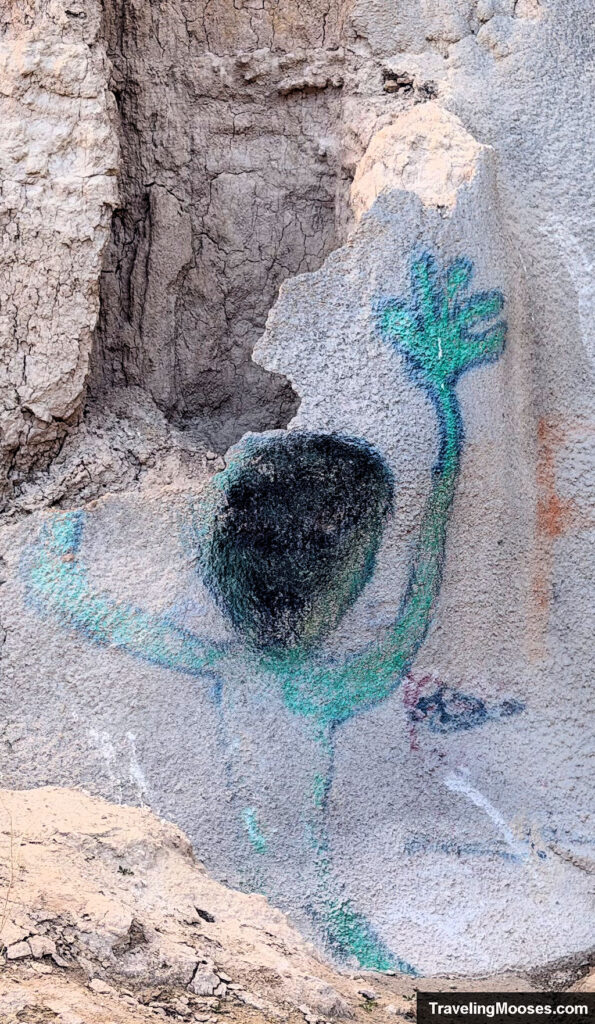
What remains today are weathered statues, aging art installations, graffiti, the remnants of a bridge, and the grave of Queho. The site shows clear signs of neglect and vandalism, with damage visible across many of its original focal points.

If you want to read more about the area check out this link or some historic photos found here.
How long you actually need
Most visitors will need about 30 minutes to walk the area and observe what remains.
We spent about 20 minutes at the site and left.
Crowds and timing
When we visited, there was no one else around. The site felt isolated and eerily quiet. Although the canyon is technically accessible at all hours, we would strongly recommend daylight visits only. The area felt increasingly uncomfortable as we prepared to leave.

Access and Visiting
We stopped at Cathedral Canyon as a historic curiosity while driving to the China Date Farm. Google Maps directions were straightforward, and the road was fully paved, though rough in places with potholes. There is a large, unmarked parking area. You can see the location on google maps here.
While the site’s original creator welcomed visitors, the area is now untended, with no signage, no safety markers, and no on-site context explaining what you’re seeing.
What we liked and what we did not
What we liked
- An unusual and unexpected place to explore
- A chance to honor the founder’s original vision by visiting
- A quick stop that broke up a longer drive
We would not recommend driving a long distance solely to see it

What we will remember the most
The eerie atmosphere, the visible vandalism, and the sense that the site’s original purpose has been largely lost. As we were preparing to leave, we heard gunshots in the distance. We did not see a nearby range and chose to leave immediately, which amplified the unease.
What we didn’t like
- Heavy vandalism throughout the site
- Trash scattered around the surrounding area, including furniture and mattresses
- No signs or historical interpretation, making it difficult to understand what you’re seeing without prior research
- Several steep, unmarked descents into the canyon, some of which felt unsafe
- Knowing that a murder occurred at the site in 2021, which further changed how the place felt
Would we go back?
No. While we respect the founder’s intention that people visit and experience the canyon, the current condition, safety concerns, and atmosphere make it unlikely we would return.

Who we would recommend this to
- Hard-core history enthusiasts
- People who enjoy off-the-beaten-path locations
- Those interested in creepy or unsettling places, with appropriate caution and awareness
Nearby ideas
This site works best as a brief stop rather than a destination, ideally paired with other planned activities in the region rather than as a standalone visit.
- China Date Farm
- Dante’s View at Death Valley
- Amargosa’s Big Bovine Cow
More Photos